
Stop the Bullying Power Loop: 10 Ways to Take Back Control


Whether you’re a kid, teen or adult you might leave interactions with some people and ask, ‘Did they just bully me?’
Whether it’s coming from peers, co-workers or family members, bullying doesn’t always look the way we expect. It can be obvious, like threats, name-calling, or physical aggression, or be quieter, like being deliberately left out, humiliated, or manipulated.
Whatever form it takes, bullying has immediate and long-term effects. Victims are far more likely to experience depression, anxiety, substance use problems and even suicidal thoughts. Because it’s often insidious and part of a larger pattern, it can feel impossible to combat.
If you have experienced bullying, you’re not alone; 20-30% of kids and teens say they have been bullied at school. You might think this decreases as we grow up, but about 30% of adults report feeling bullied at work! Diffusing the power of a bully is a life long skill we all need.
If you or a loved one has experienced bullying, it’s not your fault. Understanding the bullying cycle can be the first step toward taking the power back.
The Bullying Power Loop
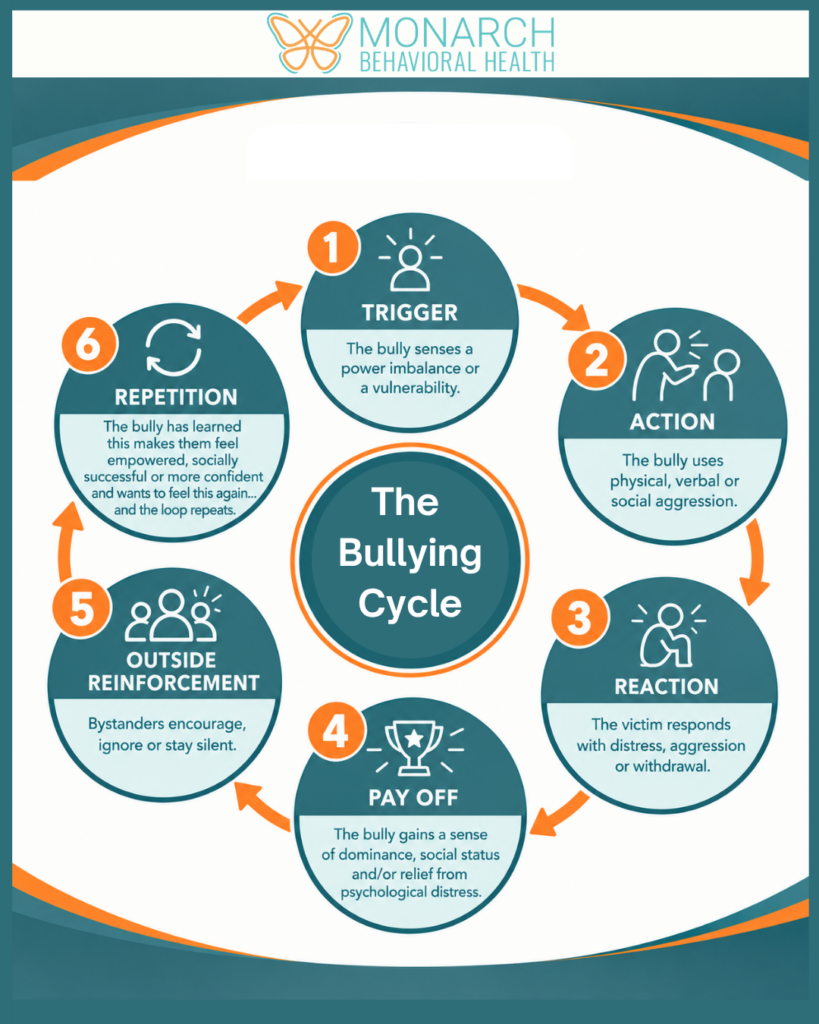
When you’re getting bullied it can feel like the same thing just keeps happening over and over, and you’re right! It’s a repeated, identifiable and describable cycle of behaviors and interactions that cause harm, intimidation, humiliation, or exclusion. Each time the bully cycles around these steps, they gain power and loop around to do it again. The better we get at describing each step in the cycle, the easier it is to take back our power.
A bully’s actions can look like:
Verbal: insults, teasing that goes too far, threats, or cruel comments
Physical: hitting, pushing, damaging belongings, or invading personal space
Social: excluding someone, spreading rumors, or turning others against someone
Relational: using friendship, approval, or rejection to control a person
Digital: harassment, humiliation, impersonation, or repeated abusive messages online
Psychological: intimidation, gaslighting, public embarrassment, or constant put-downs
Remember, not every conflict is bullying. People argue, misunderstand one another, or say things they regret. Bullying is different because it’s a pattern of behavior that repeats.
Why Do People Bully?
What’s up with bullies? Why are they doing this? Why is bullying so common in schools and workplaces?
There isn’t one “type” of person who bullies, but there are common underlying factors that lead to bullying behaviors. Understanding these factors helps us break the bullying power loop.
Bullies often want control; when a bully sees a difference in power, they often want to capitalize on it to gain more control. Why? Seeking control is our #1 coping strategy to deal with difficult emotions.
Bullies are typically experiencing inner turmoil; anxiety, depression, fragile sense of self-esteem, and insecurity in relationships. It might not look like it on the surface, but bullying patterns are actually a poor attempt at dealing with difficult emotions. Putting someone else down can give a temporary, false inflation of self-esteem and importance. But here’s the trick; it never lasts, which is why bullying is a pattern that repeats unless we use our responses to break the loop.
And let’s not forget about social status. Bullies often feel their relationships or social standing is fragile, and are seeking constant reassurance that others value them and that they ‘belong’. Unfortunately sometimes the fastest way to get that reassurance is to be cruel; bullies find that this gets attention, laughter, or approval from others.
Group dynamics also play a big role. People may join in because they don’t want to become the next target, or because they’re going along with the crowd. In those moments, the responsibility for the cruel behavior is diffused. It can feel less personal, and that can make it easier for people to ignore the harm they’re causing.
And sometimes, bullies are repeating what they’ve learned; if they have been bullied, witnessed bullying normalized or praised at home, work or school, it is much more likely they will use these patterns in an attempt to regulate their own emotions and gain control.
Understanding these factors doesn’t mean the victim needs to help the bully or is responsible for the bully’s actions. But knowing about these factors helps us learn how to short circuit the bullying cycle.
How to Short Circuit the Bullying Cycle
There’s no single, right way to respond to a bully, and having multiple tools is key. What helps depends on your situation, your age, the environment, and most importantly, your safety. When someone repeatedly uses bullying tactics, it starts to feel like they have more power than they actually do. These strategies help you short circuit the bullying cycle and take back the power.
1. Start by trusting your experience
If something keeps happening and it leaves you feeling small, anxious, or unsafe, that matters. You don’t need to “prove” it’s bullying before you’re allowed to take it seriously.
It can help to ask yourself:
- What keeps happening again and again?
- How do I feel before and after it happens?
- Is there a pattern here?
- Do I feel safe?
- Who could support me with this?
2. Tell someone you trust
There’s a common idea that you should be able to handle bullying on your own. But that isn’t realistic or fair! Bullying thrives in secrecy. Bring it into the light to banish the bully.
This is one of the most important steps, even though it can feel difficult. For children, that might be a parent, teacher, school counselor, or another trusted adult. For adults, it might be a friend, manager, HR, or someone outside the situation who can think with you clearly. Sure, telling someone isn’t going to immediately solve the problem, but you will be less alone in the struggle and have added brain power for making a plan.
Try to be specific if you can when talking to someone:
Instead of: “Everyone is against me.”
Try: “This person has made repeated comments about me this week, excluded me from meetings, and sent me messages that felt threatening.”
Details can help others understand what’s really going on.
3. Shift to action mindset: you don’t have to “tough it out”
Sure, someone might have a bad day and be rude, but if you’ve noticed this is a part of a larger pattern, it’s time to take action. Identifying the action and making a plan helps take back the power and reduce distress.
Sometimes action may include assertive tactics listed below, but just as often it includes cutting the bully’s power off in different ways such as walking away, blocking them online, changing your routine, or asking for help. These actions aren’t weakness, they are self-protection.
If there’s any risk of physical harm, physical and psychological safety always comes first. You don’t need to confront someone to prove anything.
4. Don’t give them your self-worth
A bully’s opinion of you is not a measure of who you are. Their insults may be loud, but that doesn’t make them true. When you notice yourself absorbing what they say, try reminding yourself: “That’s their behavior. It doesn’t define me.”
5. Set simple boundaries when it’s safe
Sometimes a short, calm response is enough:
- “Don’t speak to me like that.”
- “That’s unkind”
- “That’s not okay.”
- “Stop.”
You don’t need the perfect comeback. The goal is simply to name the boundary and step away.
Importantly, role playing and practicing these simple boundary setting statements will increase the likelihood you or your loved one can use them when the time comes.
6. Beat them at their own game
Look at Step 4 in the Bullying Cycle, the “Pay Off,’ and identify what the bully is getting out of this. Is it social status? Managing their own emotions? Control? Time to short circuit the cycle; if you have analyzed what they are getting out of bullying, you can be sure they don’t get it. That might mean you avoid being around them when certain other people are around to limit the social credit they get. Or, it might mean you use the ‘flip the script’ and ‘body language’ strategies below to reduce the attention or reaction they get.
7. Starve them of attention
You might feel angry, embarrassed, or tempted to get even. Those feelings make sense. But you still get to decide what happens next. Taking a breath, walking away, blocking a message, or talking to someone you trust can put you back in the driver’s seat. Your ability to regulate your own emotions in the moment steals their power.
- Starve their attention-seeking with your calm responding
- If you feel you have to respond, use very short and boring phrases with little to no emotion, “sure”, “ok”, “yep”
8. Flip the bully script
Because bullying behavior is part of a predictable pattern, the bully is expecting you to react a certain way. Practice breaking the bully cycle by flipping the script:
- Agree and confuse: If they call you a nerd, you can say, “Yeah, I actually do study a lot,” and shrug. When you agree, they have nothing left to argue about.
- Overwhelmed with indifference: Look at them and calmly say, “Are you done?” or “This is getting boring,” then look back at your phone or book.
- Laugh it off: If you act like their insult was a silly joke, it can give them hints that their words did not hurt you
9. Use Your Body Language
Our words are just one way we communicate. Your body can speak louder than your words. Showing confidence tells the bully that you are not an easy target.
To show confidence practice:
- Stand tall: Keep your shoulders back and hold your head high.
- Make eye contact: Look them right in the eye to show you are not afraid.
- Keep your hands steady: Do not fidget, cross your arms tightly, or hide your hands in your pockets.
To show indifference practice:
- Confidently remove eye contact: Look past the bully to someone or something else to show them you aren’t paying attention to them
- Shift positions: Turn your body away from them to indicate you are no longer paying attention
- Calm/bored signals: Begin to do another purposeful task (e.g., organize materials, get something out of your bag, talk to someone else)
Again, practice makes it much more likely that you can use these strategies in difficult moments.
10. Put your energy somewhere that gives back
Bullying can take up a surprising amount of mental space. Spend some of that energy reconnecting with people who make you feel good about yourself, doing things you enjoy, or pursuing something that reminds you of your strengths. Your life is so much bigger than the person who is trying to make you feel small.
If it continues… Keep a record
If bullying is ongoing, especially at work, school, or online, it can help to keep a simple record of what’s happening. Bullying behavior can be subtle and when we do a good job of documenting its patterns it’s undeniable. When seeking support and intervention from schools, bosses, or human resources, it can speed up the process if there is a clear picture of the bullying cycle.
Dates, messages, screenshots, and brief notes can make patterns of bullying clearer over time. It can also help if you decide to report it.
The goal isn’t to become better at fighting a bully. It’s to become less controlled by one.
The Bigger Picture
Bullying tends to grow in environments where cruelty is normalized, silence is expected, and people are afraid to speak up. Preventing it isn’t just about telling individuals to be stronger. It’s about building spaces, schools, workplaces, families, online communities, where respect is expected and people feel safe to raise concerns.
And for all of us, it comes back to something simple but important: Someone else’s behavior does not define your worth.
You deserve relationships where you feel safe, respected, and able to be yourself without fear.
Kids, teens, and adults who are experiencing bullying often need support in complex or chronic bullying situations. Being the victim of bullying can really ramp up anxiety and drive down mood and self-esteem. Even after the bullying stops, victims often need support through recovery. And here’s the kicker; bullies usually need help too. Their behaviors can stem from learned aggressive behaviors and deep personal insecurity.
If you or a loved one is currently or have experienced bullying, do not hesitate to make an appointment today.
Write a Comment