The fall is a very busy and exciting time for kids and families. It can bring the excitement of starting a new sport or activity, the joy of reuniting with friends after a long summer, or the possibility of a new course load for the year. However, all of these new experiences can also elicit a whole slew of worries in anxiety-prone children. While sometimes anxiety is really obvious to spot… often it’s very sneaky, manifesting in surprising ways.
Know the Sneaky Signs of Anxiety
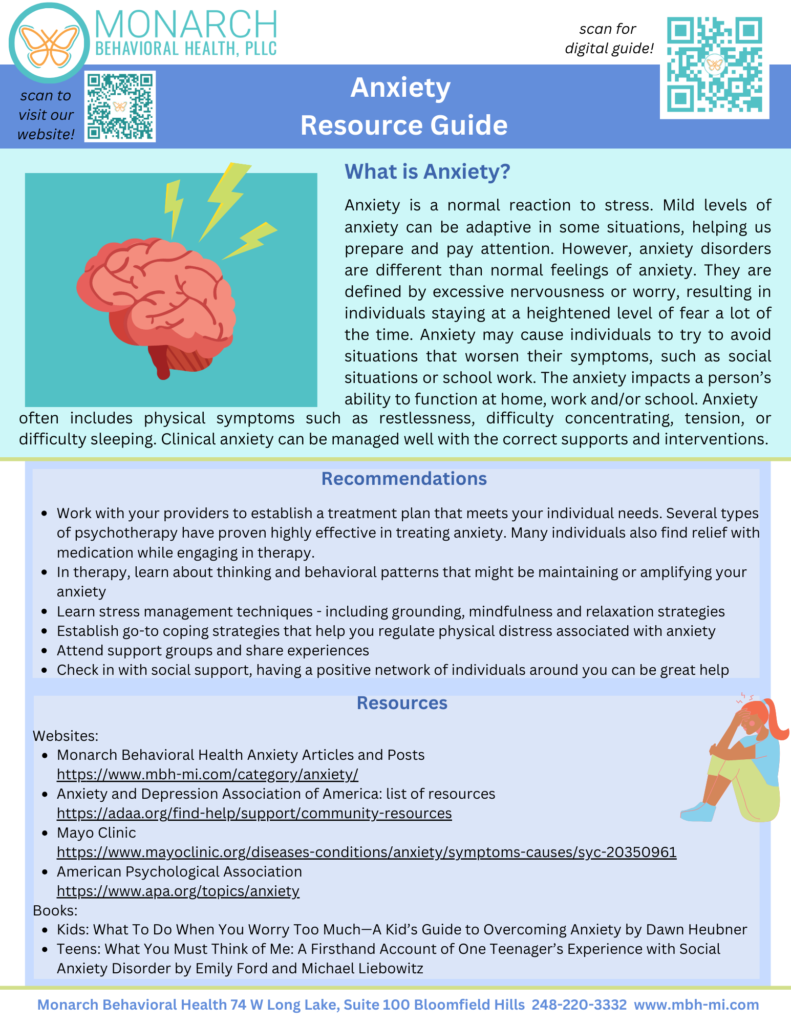
Anxiety looks a little bit different for everyone and can be tricky to spot. Knowing the common signs, as well as the sneakier signs of anxiety can help us to recognize what is going on, and better prepare us to manage it.
Here are some common and sneaky signs:
Frequent headaches or stomach aches: Anxiety has real, physiological impact on our bodies. Physical symptoms are often associated with anxiety, especially for kids. These aches and pains are not fake or for attention, they are very real! If your child is complaining of stomach aches, joint pain or headaches often with no clear medical explanation, it may be a sneaky sign of anxiety.
Avoidance: When things get scary, it can be a lot easier to pretend like the scary things aren’t happening. Kids may avoid talking about the source of their anxiety, refuse to go somewhere, have trouble getting ready, or try to avoid going or participating in the thing that makes them anxious. The behaviors kids display when trying to avoid anxiety can be really creative!
Mood changes: Anxiety reactions make us irritable and sad! Anxiety can be sneaky, wearing the mask of another emotion. Getting upset or irritated more easily can be a sign that a child is overwhelmed, worried or nervous.
Changes in eating: A child might skip eating, eat more than usual, or change their preferences regarding food. This can be a sign of underlying anxiety. Without knowing, they may be making an attempt to control things that feel “out of control” by restricting food intake, avoiding certain foods, or overeating.
Clinginess: Separation is hard, and if a child is showing signs of not wanting to be apart from their parents or having a hard time separating from parents, it can be a sneaky sign of larger worries. For older kids, this might look like constantly texting parents to gain reassurance.
Defiance: Defiance is often a sign of underlying anxiety in kids. Their outwardly defiant behavior may be an attempt to cope with overwhelming feelings and situations. Recognizing this connection can help parents address the root cause and provide appropriate support.
The Take Home
Anxiety can be a sneaky culprit to spot; our kids have very creative ways to get their needs met and oftentimes their outward behaviors or emotional reactions don’t obviously point to anxiety. But as parents and providers, we can work together to spot these signs and patterns and ensure your child gets the support they need to thrive.
Additional support in understanding anxiety is available. Call our office and get connected with one of our specialists.
Wishing you and your child a happy and healthy fall season!
On August 30th we observe National Grief Awareness Day. This day is dedicated to raising awareness of the countless ways in which individuals cope with loss. There is no correct or wrong way to grieve and cope with the loss of our loved ones. Grieving changes our brains and how we process; our experience of grief cannot be predicted! We tend to describe loss metaphorically, like losing a part of ourselves. Our brains have a (metaphoric) hole where the “we” lived. Our brains experience the loss every time we expect to see a loved one walking in the room, or we pick up the phone to call them and remember we cannot. We then are faced with the most unthinkable reality: How do I live in a world they are not in? How do I cope with the unimaginable? The vast majority of us do find ways to cope and restore meaning in our lives after the death of a loved one. Today we spend time acknowledging our grief, and how we find the courage to cope today and every day.
Am I Doing it Right? Absolutely You Are.
All the Feelings
I want to point out once more that there is no correct way to navigate the grieving process nor can you compare your experiences to others. Grief is a natural response to loss, and we do not experience grief in linear stages. We should expect to feel all the feelings with no timeline attached. If we set up expectations of when we should be done healing, we can feel like we failed at grief. We can feel like we failed at “overcoming” our grief and moving into a state of acceptance. There is nothing productive or helpful that comes from shrouding our grief in shame. The anger, exhaustion, panic, disbelief, yearning, depressed mood can come in waves, whether it is felt like a gentle summer breeze or a tsunami after a loss is experienced. Yearning declines and acceptance rises over time. When we spend time acknowledging and processing our complex feelings and coping with emotions, it allows us an opportunity to continue living a meaningful life after loss.
Your New Toolkit You Did Not Ask For
We’ve all heard the saying “Time heals all wounds”. It’s how we use that time to keep moving in the world when we feel unbalanced after a loss. The most reliable predictor of good mental health is having a large toolkit of strategies to deal with our emotions. Everyone is handed a new empty toolkit at the beginning of the grieving process. We carry that toolkit with us everywhere we go and add to it as we experience grief. We add all the big important tools that keep us moving through the holidays & anniversaries, and all the little Band-Aids to help us get through the everyday moments. When a loved one dies, we are thrown into a new reality where we often change our habits. It’s common to avoid old habits like past shared experiences and have little interest in creating new memories. The avoidance of these things can in the short term protect us from overwhelming feelings of guilt and shame. For example, “if I enjoy this without them, it means I do not love them or miss them.” However, avoidance tends not to be a helpful strategy in the long-run. It’s important to fill your toolkit with strategies that will help you continue to courageously wake up every morning when experiencing intense grief. This can look like focusing on new hobbies, learning relaxation strategies, finding distractions, and reaching out to your social support network. It can also mean talking with a professional if you feel like your toolkit isn’t quite doing the job! Talking with a professional can help you when you get derailed from the natural healing process. The goal is to help you build the skills for your toolkit, not to stop your grief, but help you persevere in moving forward.
The Address Book
During times of grieving, our village can be an immense source of support. Lean into them! Your village can help accomplish tasks that feel too overwhelming initially after loss. They can provide comfort, a listening ear, a shoulder to cry on. They can be the people who go out into the world and try new things with us! There will be times where alone time will feel more appropriate than company. It’s helpful to consider in what ways could your village help ride the wave of grief. If you were able to come up with ways in which you think they could bring help- then welcome them in!
How to Support others Grief
If you are in the village of someone who is grieving, you may feel at a loss of how to support them. Watching our family and friends experience intense grief can be insurmountable. It can leave us with a sense of unease and at a loss for what to say or do to support them. We may feel we say too little or too much. We may find ourselves struggling with how much to be present and when to give space. Tears can make us uncomfortable. The inclination may be to “cheer” them up or give them a reason to smile. What’s the right approach?
First, Stay Present.
This may sound obvious, but stay present however long and in whatever shape you can. This is my reminder to you to continue to check in on your people periodically on those random Wednesday afternoons where the checklist of chores is endless and practices/events go well into the evening. This can be accomplished in numerous ways! It can be in the form of a phone call checking in, an uplifting text message, periodically mailing cards, bringing over carry out or a home cooked meal, or scheduling times to meet up with the grieving individual/family. A lot of support from the community comes pouring in immediately after a loss, but it filters off as time goes on and others’ focus shifts back to their own busy lives. You may feel a pang of doubt or a sense of indecision. “Should I text them? I don’t know, I don’t want to bother them.” Just do it. You may wrestle with the indecision of when the right time is to reach out. They will appreciate receiving the reminder that they are loved and have a village around them holding them close.
But What Do I Say?
You may be at a loss for words. What is the right thing to say to someone grieving? First, be willing to sit with their pain and avoid attempting to fix the unfixable. Acknowledge you are there for them backed with action! I’m here for you even if it’s just to sit and listen. I’m here for you even though I can’t make it better. It’s helpful to acknowledge their pain and share your love for them. You could share a positive memory of the person who has died. You could simply hold their hand and be a safe space for your village members to talk about.
Don’t Ask, Anticipate
When at a loss for words, turn to actions! A common occurrence is to reach out to that individual in your support system and remind them you are here for them and willing to help in any way they need. Asking or accepting help can be draining or overwhelming. Instead, support them by setting up concrete times you will be available. You could text and let them know you will be dropping off a meal that week and inquire about the best day to drop off. You could take notice of the chores that need to be accomplished, like cutting the grass, grocery shopping, walking pets, child care. You could provide options for distractions at various levels of intensity (going out or staying at home). Set up the expectation that you will be helping follow through.
In Conclusion…
The grieving process will differ for each individual. It is as unique as we are, but the only way through it is through it. By building your toolkit, utilizing the support available to you, and even reaching out for professional help when needed, you too will find ways to keep going. Remember, grief is not limited to our experience after the death of a loved one. Any significant loss can stir up feelings of grief. For example, we can experience grief after:
-the loss of a pet
-the ending of a significant relationship
-the loss of a job
-the loss of physical functioning/medical related changes
Embrace your resilience and know that every step forward, no matter the size, is a step forward. Lastly, it is okay to not be okay. Be kind and compassionate with yourself. The grief you feel is a sign of your love and connection. You are supported and not alone.
If you feel you or a loved one may benefit from additional support, call our office at 248-220-3332 or click here to schedule an appointment.
We are often our own worst critics. Whether I am working with high-achieving, “type-A” executives and physicians, overwhelmed parents, or a self-conscious middle schooler, I see so many people criticize and berate themselves for not meeting a goal, for saying something they wished they hadn’t, or worrying about a future performance. Theodore Roosevelt once said that “comparison is the thief of joy.” Not only do we compare ourselves to others, but often the bigger loss of joy comes when we compare ourselves to an internal standard that may feel impossible to reach, leading to self-criticism and eventually anxiety, depression and low self-esteem. Mindful Self-Compassion is a mindfulness practice that is centered around giving compassion and care to yourself. At its heart, mindful self-compassion is non-judgmental and loving. It is not falsely inflating your ego, nor an excuse to dismiss problematic behaviors or choices, but rather It is about giving yourself grace and generosity, particularly during difficult times. It is about recognizing and honoring your inherent value and worthiness of care as a human being. Mindful Self-Compassion can be a powerful self-soothing coping strategy during times of stress, as well as a way to build one’s resilience to better manage future stressors. Founded by Drs. Kristen Neff and Christopher Germer, mindful self-compassion has established a strong body of research support over the past twenty years, helping with resilience building, depression, anxiety PTSD, body image, conflict resolution and more (see Dr. Neff’s website for relevant studies: https://self-compassion.org/the-research/ ). More recently, other clinicians are developing new applications for Mindful Self-Compassion including programs for OCD and infertility.
Mindful Self-Compassion can be incorporated into individual therapy (as I do with patients in my practice) or it can be a part of your personal meditation or mindfulness practice. I often begin by having individuals complete a Self-Compassion test (https://self-compassion.org/self-compassion-test/) to get a sense of where what their current levels of self-criticism and judgment vs self-compassion fall. The experience can be a powerful tool to reflect on the messages we give ourselves and the impact it has on overall well-being, self-esteem, and mood. The next steps include learning about Mindfulness Self-Compassion and exploring the origins behind the person’s inner critic as well as identifying sources of love and compassion. We then proceed to practicing guided meditations. The mindfulness aspect allows for a “pause” between a triggering event and our initial gut reaction to criticize and self-flagellate. Over time, the goal is to lower the volume on our inner critic and change the messages to ones that are more kind and compassionate.
Resources and Further Reading
https://self-compassion.org/Dr. Neff’s website, filled with further information about MSC, links to videos and podcast, research, guided practices, training and events
https://centerformsc.org/ The Center for Mindful Self-Compassion, offers training resources to develop your practice
Books By Kristen Neff, PhD:
Self-Compassion: The Proven Power of Being Kind to Yourself
Fierce Self-Compassion: How Women Can Harness Kindness to Speak Up, Claim Their Power, and Thrive
The Mindful Self-Compassion Workbook: A Proven Way to Accept Yourself, Build Inner Strength, and Thrive (co-authored with Chris Germer)
Mindful Self-Compassion for Burnout: Tools to Help You Heal and Recharge When You’re Wrung Out by Stress (co-authored with Chris Germer)
Books By Other Authors:
The Mindful Path to Self-Compassion: Freeing Yourself from Destructive Thoughts and Emotions by Christopher K. Germer and Sharon Salzberg
Self-Compassion for Educators: Mindful Practices to Awaken Your Well-Being and Grow Resilience by Lisa Baylis
The Self-Compassion Workbook for Teens: Mindfulness and Compassion Skills to Overcome Self-Criticism and Embrace Who You Are by Karen Bluth PhD
The Self-Compassion Workbook for Kids: Fun Mindfulness Activities to Build Emotional Strength and Make Kindness Your Superpower by Lorraine M. Hobbs MA, and Amy C. Balentine PhD
The Self-Compassion Workbook for OCD: Lean into Your Fear, Manage Difficult Emotions, and Focus On Recovery by Kimberley Quinlan LMFT and Jon Hershfield MFT
Written by: Bismah Khan, MA, LLPEdited by: Julie Braciszewski, PhD, LP
Many of us want to support and prioritize mental health for our LGBTQIA+ loved ones but may feel lost in how to do so. Wanting to learn how to support effectively is already the first step in the right direction.
If you identify as an ally (i.e,; a person, often heterosexual/cisgender, who supports the wellness and equality of LGBTQIA+ individuals and community), you can show your loved ones you care and accept them by some simple actions.
Visual Actions
Using simple visual cues to let the LGBTQIA+ community know you are a safe person or organization can go a long way in casual or initial interactions. Individuals who identify under the LGBTQIA+ umbrella regularly experience fear and discrimination, and offering a quick visual cue can help pave the way for reduced anxiety and open communication. Putting an ally sticker on your laptop or water bottle, stating your pronouns in email signatures or when meeting someone new, showing up to local Pride celebration events such as parades, fundraisers, or festivals, are very visual ways to communicate your support.
Verbal Actions
You can use your own unique voice to lift up the LGBTQIA+ community by expressing support and sharing information. Pride Month acknowledges the progress the LGBTQIA+ community has made while recognizing the individuals whose sacrifice and hard work made such progress possible. Take some time this month, in between all the celebrations for the community, to also educate yourself on how societal issues disproportionately impact the LGBTQIA+ community while also brushing up on your LGBTQIA+ terminology.
Open and Genuine Connection
Fostering a mindset of openness and genuine connection during Pride Month allows you to grow while expressing empathy and validation. When individuals experience genuine empathy and connection, it positively impacts mental wellness. Allow others to share their experiences with you – whether that’s related to discrimination and hardship or joy in being in a queer relationship. Learning about individuals’ unique experiences and well as LGBTQIA+ history, are great ways to show your mindset of openness and genuine connection.
My hope is that whether you have a friend, child, partner, acquaintance, or co-worker who is part of the queer community, this blog provides you with some easy and meaningful ways to show your support. I hope this Pride month is full of rainbows, celebrations, joy, and sense of community for you.










Recent Comments